Business cycles · India + global · 2023
Why Silicon Valley Bank Collapsed in 2023: Bond Losses and a Bank Run
Why Silicon Valley Bank failed in March 2023: how rising rates, bond losses and fast withdrawals came together, and why the story matters in India.
By Vimista EditorialPublished Updated 7 min read
Contents · Jump to a section
Suppose you put money in a Fixed deposit versus bondAn FD pays the agreed rate under its terms. An existing bond can change in market price when new bonds offer different yields.View topic and related stories at 5 percent interest. A few months later, banks start offering 7 percent on new FDs. Does that hurt you? Not really. Your FD keeps paying the 5 percent you agreed.
Now think of a bond. It also pays a fixed amount, but you can sell it to someone else. If new bonds pay more, why would anyone pay the full price for your older, lower-paying one? They wouldn’t, so you may have to sell it for less.
That small idea sits at the heart of the Silicon Valley Bank (SVB) collapse. This US bank had put a lot of money into long-term bonds, and their market value fell as interest rates rose. Then customers rushed to take their deposits out, and the bank could not find the cash fast enough. California’s regulator closed SVB on 10 March 2023.
But the bonds are only half the story. The other half is the people who kept their money in the bank, and how quickly they wanted it back.
Why SVB had so much money to look after
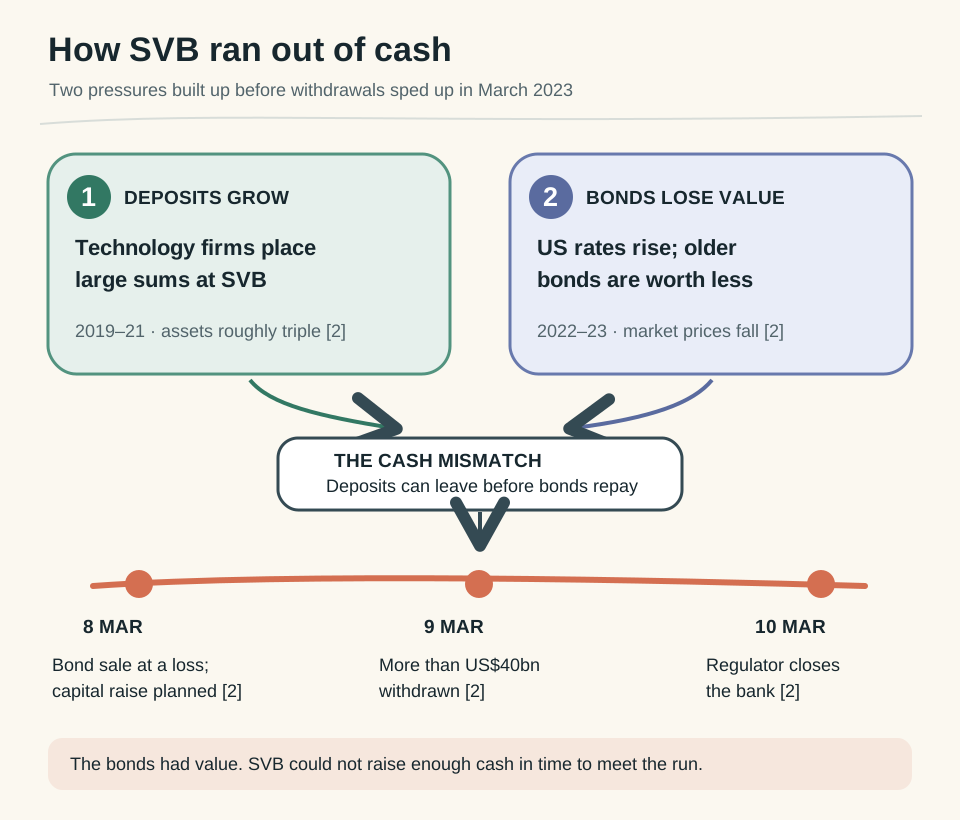
SVB mainly served technology start-ups and the investors behind them. Many of these start-ups were funded by venture capital (VC), money invested in young companies in the hope that they grow. During the funding boom of 2019 to 2021, they placed large deposits with SVB and spent from them slowly, on salaries and bills.
What does a bank do with all that money? It lends some, invests some and keeps some as cash for withdrawals. It never keeps everyone’s money sitting idle. So every bank has to keep asking: how much cash might customers want, and how fast can I get it?
At SVB, that question was harder than usual, because the customers were so alike. Many belonged to the same technology and VC network. If funding slowed, several of them would need their savings at the same time. And if one grew nervous about the bank, the worry could reach the others quickly.
They also had a lot to lose. Deposit insurance covers deposits only up to a limit, and about 94 percent of SVB’s deposit value was Deposit insuranceDeposit insurance protects eligible deposits up to a stated limit. The limit and rules depend on the country and the bank.View topic and related stories at the end of 2022. That gave customers a strong reason to withdraw at the first sign of trouble.
Why its bonds lost value
SVB had put much of those deposits into long-term US government bonds and similar government-backed securities. They were safe in one way: the chance of not being paid back, called credit risk, was low. But safe from missed payments is not the same as safe from falling prices. When newer bonds offer better returns, buyers pay less for older ones. This is Credit risk and interest-rate riskCredit risk is the chance of missed payment. Interest-rate risk is the chance that changing rates lower an asset's market value.View topic and related stories.
Here is a simple, hypothetical example in rupees. A 10-year bond pays ₹5 a year and promises ₹100 back at the end. A similar new bond now gives a 7 percent return. To earn 7 percent from the older bond, a buyer would pay only about ₹86. Nobody has missed a payment. The old bond just looks less attractive at its old price (simplified calculation, assuming yearly payments).
The longer a bond has to run, the bigger the fall, because you are stuck with the lower payments for more years.
That is what happened to SVB in 2022. The US central bank, the Federal Reserve (the Fed), kept raising its key interest rate. As rates climbed, SVB’s older bonds lost market value. At the same time, customers began taking deposits out.
When a paper loss turns into a cash problem
Does a fall in a bond’s price mean the owner has already lost money? Not yet. In our example the bond may sell for ₹86 today, but it still promises ₹5 a year and ₹100 at the end. If you can wait, you don’t have to sell at today’s price. Until then the loss is only on paper. Once you sell, it becomes real: you get back less than you paid, here ₹14 less on every ₹100.
A bank often cannot wait. Its customers can withdraw today, while many of its bonds repay only after years. The bonds are the bank’s assets, and the deposits are what it owes. When money can leave sooner than it comes back, that is an Asset–liability mismatchA timing mismatch arises when a bank's deposits can leave soon but its loans or bonds repay much later.View topic and related stories. Waiting only works if you can also pay the bills that fall due along the way.
So how does a bank find cash? It can use what it has, sell bonds, or borrow against its bonds by offering them as security, called collateral. Borrowing avoids selling at a loss, but only if the arrangements are ready when the money is needed. The Fed found serious gaps in SVB’s planning for exactly that.
Other US banks also held bonds worth less than they paid. That alone did not put them at risk. SVB combined falling bond prices with large, mostly uninsured deposits that customers could pull out together. In March, that possibility turned into a real demand for cash.
Three days in March
On 8 March 2023, SVB announced that it had sold US$21 billion of securities at an after-tax loss of US$1.8 billion. It also planned to raise US$2.25 billion of Bank capitalCapital is the cushion that absorbs losses for a bank's owners. It is different from the cash used to pay depositors today.View topic and related stories from investors, to help absorb losses. The plan was meant to steady the bank. But it also showed customers how strained the bank was.
On 9 March, depositors withdrew more than US$40 billion. The Fed’s review described worries about the technology sector, and because customers were so closely connected, concern spread fast.
By the morning of 10 March, SVB expected more than US$100 billion in further withdrawals that day. It did not have enough cash or usable collateral to meet them. California’s financial regulator closed the bank and handed it to the Federal Deposit Insurance Corporation (FDIC), the US deposit-insurance agency. This is a Bank runA bank run occurs when many customers withdraw quickly and the bank cannot raise enough cash to meet them in time.View topic and related stories: many customers try to withdraw at once, and the bank cannot raise cash fast enough.
What happened next
The first question was whether depositors above the insurance limit would get their money. On 12 March, US authorities decided to protect all SVB depositors, who could reach their money from Monday, 13 March. Shareholders and some lenders who held no security were not protected, and taxpayers were not to bear the losses.
The same day, New York’s regulator closed another US bank, Signature Bank. The Fed also set up a lending programme that let eligible banks borrow for up to a year against certain bonds, valued at their face value instead of their lower market price. That gave banks a way to find cash without selling bonds at a loss. It responded to the kind of pressure SVB faced; it did not undo SVB’s closure.
The worry travelled. On 19 March, UBS agreed to take over Credit Suisse in Switzerland, with public support. On 22 March, the Fed raised rates again and warned that stress on banks could make loans harder to get. These events came close together, but that alone does not show that SVB caused the Credit Suisse takeover.
The Fed’s later review found that SVB’s leaders had not managed interest-rate and cash risks well enough, and that supervisors had not acted forcefully enough. Rising rates exposed these weaknesses, but they do not explain the failure on their own.
What it meant for India
Some Indian start-ups and investors had money at SVB. On 14 March, the Ministry of Electronics and IT said its minister had spoken with over 450 start-ups, investors and others. They were worried about moving dollar deposits to India or to US branches of Indian banks. The government said it would explore credit lines for those whose deposits were protected but temporarily out of reach. It gave no total for their deposits at SVB.
The Reserve Bank of India (RBI) said in April that the Indian banking system remained sound and that it was watching developments abroad. It kept its repo rate, the rate at which it lends short-term money to banks, at 6.50 percent. Its later Financial Stability Report pointed to strong cushions against losses and few bad loans in Indian banks. That helps explain the RBI’s view, but it does not show whether Indian banks had any exposure to SVB.
For an Indian saver, the lesson goes back to the FD we started with. If new FDs offer 7 percent, your older FD still pays the 5 percent you agreed. The rate rise does not reduce the amount you deposited.
A bond mutual fund works differently. It holds bonds at market prices, so when bond prices fall, so can the value of your investment. And a bank holding bonds faces another question: can it find cash when depositors want theirs? The same rate rise affects each of these in a different way.
What to remember
SVB shows why “safe” needs a follow-up question: safe from what? Its bonds were safe from missed payments, but their market prices fell as rates rose. Someone who can wait for repayment faces a different problem from a bank that needs cash today.
Before relying on an asset to meet a payment, ask three things: when will it repay, can I sell it sooner, and what would selling early cost? A bank can expect its investments to repay in full over time and still be unable to pay its customers today.
Sources
Show 12 sources
- Reserve Bank of India, “Governor’s Statement”, 6 April 2023
- Board of Governors of the Federal Reserve System, “Review of the Federal Reserve’s Supervision and Regulation of Silicon Valley Bank”, 28 April 2023
- Board of Governors of the Federal Reserve System, U.S. Department of the Treasury and Federal Deposit Insurance Corporation, “Joint Statement by Treasury, Federal Reserve, and FDIC”, 12 March 2023
- Federal Deposit Insurance Corporation, “Signature Bank, New York, NY” (failed-bank page)
- Board of Governors of the Federal Reserve System, “Open Market Operations” (policy-rate history table)
- Board of Governors of the Federal Reserve System, “Federal Reserve issues FOMC statement”, 22 March 2023
- Federal Deposit Insurance Corporation, “Quarterly Banking Profile, Fourth Quarter 2022”
- Federal Deposit Insurance Corporation, “FDIC Acts to Protect All Depositors of the former Silicon Valley Bank, Santa Clara, California”, 13 March 2023
- Board of Governors of the Federal Reserve System, “Federal Reserve Board announces it will make available additional funding to eligible depository institutions”, 12 March 2023
- Swiss Federal Department of Finance, “UBS/CS takeover: contracts”
- Reserve Bank of India, “RBI releases the Financial Stability Report, June 2023”, 28 June 2023
- Press Information Bureau, Ministry of Electronics and IT, “MoS Rajeev Chandrasekhar interacts with over 450 Indian Startups on the recent collapse of Silicon Valley Bank (SVB)”, 14 March 2023
Topics
- Bank run
- Svb
- Interest rates
- Bond prices
- Banking crisis
- Contagion
- Start ups
- Bank deposits
- Fd versus bond
- Bond basics
- Bond price and yield
- Policy rates and market rates
- Credit and interest rate risk
- Liquidity
- Asset liability mismatch
- Collateralised borrowing
- Deposit insurance
- Depositor concentration
- Unrealised and realised loss
- Bank capital
- Systemic risk exception
- Central bank emergency lending
- Venture capital and startup deposits
- Repo rate
- Fixed deposit
- Mutual fund nav
- Mark to market
- Government securities