Business cycles · India + global · 2026
The 2026 Strait of Hormuz Oil Supply Disruption, Explained
How tanker traffic through Hormuz nearly stopped in March 2026, why oil prices rose, and what India's official records show about crude and LPG supply.
By Vimista EditorialPublished Updated 7 min read
Contents · Jump to a section
How can trouble in one narrow sea passage affect oil prices around the world—and the cooking gas used in India?
In late February 2026, military action in West Asia made it dangerous for tankers to pass through the Strait of Hormuz. Most stopped using the route. Buyers were still waiting for oil, but it could no longer leave the region as usual. Storage tanks began filling, some producers cut production, and prices rose.
India now faced two immediate questions. Could refineries get enough crude oil? And could cooking gas keep reaching households and businesses?
This account covers late February through March 2026, using reports published up to the US Energy Information Administration’s (EIA) April review.
Why this narrow passage mattered
The Strait of Hormuz connects the Persian Gulf to the open ocean. Oil from several Gulf producers normally travels by ship through Hormuz before reaching buyers elsewhere. This makes it a Shipping chokepoint and freight costA chokepoint is a narrow sea passage that many ships must use. If ships have to avoid it, voyages get longer and freight and insurance costs can rise, which raises the cost of imported goods even when the goods are available.View topic and related stories: a narrow passage on which a large amount of trade depends.
According to the International Energy Agency (IEA), about 20 million barrels of crude oil and oil products passed through it each day in 2025. That was roughly one-quarter of the world’s oil trade carried by sea.
The strait lies between Iran to the north and Oman’s Musandam peninsula to the south. The Gulf is bordered by major oil producers such as Saudi Arabia, Iraq, Kuwait, the UAE and Iran. Beyond it are the Gulf of Oman and the Arabian Sea, the way out to buyers in Asia, including India.
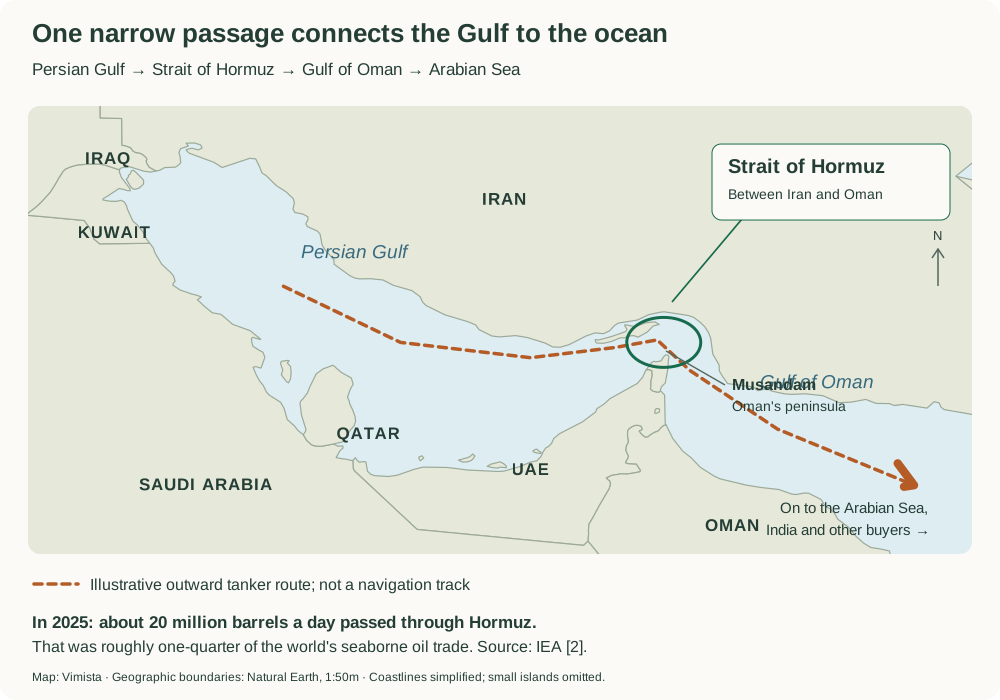
Dashed arrow: illustrative tanker route. Map: Vimista / Natural Earth. Oil-flow figures: IEA.
When ships stopped passing through Hormuz, buyers could not simply move all those deliveries to another route. Some supplies could be replaced or rerouted, but the alternatives were limited.
What happened when the ships stopped
Military action began on 28 February 2026. The EIA says most tanker traffic through Hormuz then stopped because ships risked physical damage. By 11 March, the IEA reported that crude and refined-product exports through the strait had fallen below 10% of their pre-conflict level.
Why would a shipping problem force an oil producer to cut production?
Crude oil is the raw material that refineries turn into petrol, diesel and other fuels. Once it comes out of the ground, it needs somewhere to go. Normally, storage tanks hold it until a tanker takes it away. But if tankers cannot load and leave, storage tanks fill up. Once there is little room left, the producer has to slow or stop production.
In its 12 March report, the IEA estimated that producers had cut crude output by at least 8 million barrels a day, with barrels being the standard unit used to measure oil. Production of a further 2 million barrels a day of condensates and natural-gas liquids—other liquids produced alongside oil and gas—had also stopped.
Why oil prices rose
A refinery needs crude to keep making fuel. If it can no longer count on its usual shipment, it looks for another seller. When many buyers do this together, they compete for the supplies that can still be delivered. Transport and insurance can also become more expensive when ships face greater risks.
Prices can therefore rise before a refinery actually runs out. Buyers need oil now, and they are also worrying about whether the next delivery will arrive.
To follow the price change, the EIA used Brent, a widely used reference price for crude oil. It tracked the front-month futures contract, which is for delivery in the nearest delivery month. That gives us a market reference, rather than the exact price paid for every shipment.
That price started 2026 at $61 a barrel, reached $72 by the end of February, crossed $100 on 12 March, and ended March at $118.
The rise had already begun as fears of conflict grew. It became sharper after shipping was disrupted. Attacks and threats to energy facilities also affected supplies, so Hormuz alone does not explain every price change.
Finished fuels were affected too. The EIA reported particularly strong price rises in diesel and jet fuel after exports from West Asia were disrupted. But crude, diesel and petrol each have their own markets. A rise in Brent does not tell us exactly how much an Indian petrol-pump price will change.
Could stored oil help?
With regular shipments disrupted and prices rising, countries turned to emergency oil reserves. On 11 March, IEA member countries agreed to make 400 million barrels from those reserves available to the market.
Stored oil can help meet demand while regular deliveries are delayed. But releasing and delivering it takes time. The announcement did not mean all 400 million barrels reached the market that day. And using reserves cannot make the sea route safe again.
What changed for India
Emergency stocks could provide temporary relief. India also needed replacement supplies that could reach its refineries without passing through the disrupted route.
In its 12 March statement to Parliament, the Ministry of Petroleum and Natural Gas said about 45% of India’s crude imports had passed through Hormuz before the conflict. By then, the share coming through other routes had risen from 55% to about 70%. The ministry said refineries were operating at high utilisation, meaning they were using a large share of their processing capacity.
Buying from elsewhere helped get oil delivered. But would it also protect India from higher prices?
Taking another route does not shield India from an Oil import price shockWhen a country imports much of its crude oil, a higher dollar price can raise its import bill and feed into domestic costs. The effect depends on volumes, the exchange rate and how prices are passed on.View topic and related stories. The cost of an imported barrel depends on the price paid, the exchange rate, freight and the contract. Freight is the cost of transporting the cargo. If world prices rise, a replacement shipment may cost more too.
Why cooking gas needed a separate response
India could replace some crude shipments, but cooking gas depended more heavily on supplies passing through Hormuz. Cooking gas is liquefied petroleum gas (LPG), and keeping it available required a separate response.
On 12 March, the ministry said India imported roughly 60% of its LPG requirements from Gulf countries and produced the rest domestically. A separate briefing that day said about 90% of India’s LPG imports normally passed through Hormuz.
The two percentages use different totals: 60% of all LPG needs, and 90% of imports. The latter does not mean 90% of all cooking gas used in India travelled through Hormuz.
To reduce the supply pressure, the government directed refineries to produce more LPG and gave priority to household cooking-gas supply. By 12 March, the ministry reported that domestic LPG production had increased 28% over the preceding five days. The ministry also described purchases from alternative sources and controls on how limited commercial LPG supplies were distributed.
The ministry said household deliveries remained protected. Its statement does not tell us what every household experienced throughout the disruption.
Keeping cylinders available still left the question of price. The parliamentary statement put the Delhi price of a 14.2 kg non-subsidised household cylinder at ₹913, after a ₹60 increase. It did not establish how much of that increase was caused by Hormuz alone.
What to remember
The disruption spread from shipping to production, prices and fuel supply. Emergency reserves bought time, while India sought alternative crude shipments and increased domestic LPG production. These measures helped manage the interruption, but restoring regular shipping still mattered.
Sources
Show 5 sources
- International Energy Agency, “Oil Market Report - March 2026”, 12 March 2026
- International Energy Agency, “IEA Member countries to carry out largest ever oil stock release amid market disruptions from Middle East conflict”, 11 March 2026
- US Energy Information Administration, “Crude oil and petroleum product prices increased sharply in the first quarter of 2026”, 7 April 2026
- Ministry of Petroleum and Natural Gas, “Statement by Union Minister for Petroleum and Natural Gas in Parliament on Measures Taken to Address Global Energy Supply Disruptions Arising from the Conflict in West Asia”, 12 March 2026
- Ministry of Petroleum and Natural Gas, “Inter-Ministerial Briefing on recent Developments in West Asia”, 12 March 2026