Business cycles · India + global · 2024
Red Sea Shipping Diversions 2024: How a Longer Route Raised Trade Costs
The Red Sea shipping diversions of 2024 explain how a longer journey raises costs, ties up business money and can affect everyday prices.
By Vimista EditorialPublished 6 min read
Contents · Jump to a section
The goods were still available, and ships could still carry them. Yet after attacks on shipping in the Red Sea, many deliveries became slower and more expensive. Shipping lines were taking a longer route around Africa to avoid the danger, adding distance to journeys that would normally pass through the Suez Canal.
The Red Sea shipping diversions of 2024 help explain something easy to overlook when buying goods: the supplier’s price is only part of what it costs to get them. The journey matters too, including how long the buyer has to wait.
Why a canal matters to a shipment
For a ship travelling between Asia and Europe, the Suez Canal provides a shortcut. Instead of sailing around Africa, it can pass through the Bab al-Mandab strait into the Red Sea, then through the canal into the Mediterranean. Many businesses depend on this route to receive supplies and deliver orders.
Suez is therefore a Shipping chokepoint and freight costA chokepoint is a narrow sea passage that many ships must use. If ships have to avoid it, voyages get longer and freight and insurance costs can rise, which raises the cost of imported goods even when the goods are available.View topic and related stories: a narrow passage that many ships depend on for their usual journey. When that passage becomes unsafe, the effects reach buyers and sellers far from the trouble itself. The UN trade agency estimated that Suez normally handled about 12% to 15% of global trade.
Much of this cargo travels in containers, the large steel boxes that hold everything from clothes to machine parts. Shipping companies sell space on scheduled voyages, and businesses plan around those arrivals. A factory may be waiting for a part; a shop may need stock before its existing supply runs out. Changing the route can unsettle those plans even if the cargo eventually arrives.
What changed from November 2023 to January 2024
Attacks on merchant ships by the Yemen-based Houthi group began in November 2023. In January 2024, the UN Security Council condemned the attacks, which had affected shipping connected to more than 40 countries.
Many shipping lines began avoiding the Red Sea and sending vessels around the Cape of Good Hope, at Africa’s southern tip. By late January, container-ship crossings through Suez had fallen sharply. Tankers and ships carrying loose cargo such as grain and ore were also affected, though their traffic fell less sharply.
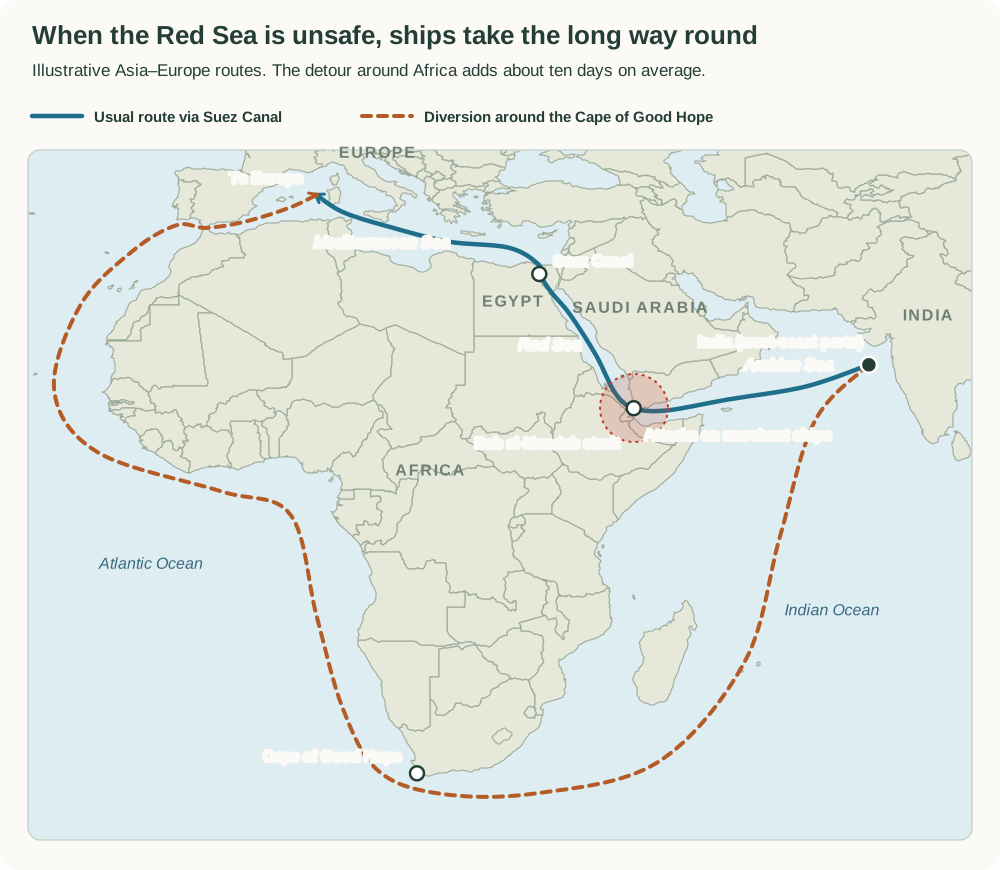
Routes are illustrative, not navigation tracks. Extra journey time: IMF and India’s Economic Survey. Illustration: Vimista, using map outlines from Natural Earth.
The detour allowed goods to keep moving, but the voyage took longer. The IMF reported that deliveries were taking ten days or more extra on average in early 2024. India’s Economic Survey also described about ten additional days for Asia-Europe journeys, along with higher fuel costs. For a business expecting a shipment, the problem now included both the extra transport bill and the longer wait.
Why a longer route raises the price at the port
A ship sailing farther uses more fuel and keeps its crew occupied for longer. It also takes longer to return for another load. So the same fleet can carry fewer shipments over a given period, even though no ships have disappeared. When businesses are competing for that available space, shipping prices can rise alongside the extra cost of the journey.
The price paid to transport goods is called the freight rate. During the disruption, the UN trade agency reported sharp increases in rates for new container bookings out of Shanghai, including shipments to Europe. These were spot rates, meaning prices available for a booking at that time. A business with a price already agreed under a longer-term contract would not necessarily face the same increase.
To see what this means for a buyer, imagine an Indian business importing machine parts from Europe.
Hypothetical example. The parts cost ₹10,00,000. On the usual route, freight costs ₹60,000 and insurance costs ₹10,000. Suppose the longer route raises freight to ₹1,80,000 and insurance to ₹20,000.
| Cost | Usual route | Longer route |
|---|---|---|
| Machine parts | ₹10,00,000 | ₹10,00,000 |
| Freight | ₹60,000 | ₹1,80,000 |
| Insurance | ₹10,000 | ₹20,000 |
| Total before duties and port charges | ₹10,70,000 | ₹12,00,000 |
The supplier has not raised the price of the parts, but the buyer needs ₹1,30,000 more to bring them to port. This is why businesses look at the landed cost: what it costs to get the goods to their destination, including transport and other applicable charges. Our simplified example leaves out import duties and port charges. Its figures are invented to explain the idea, rather than actual 2024 shipping rates.
Now consider the wait. If the importer has already paid for those parts, its money remains tied up while they are at sea. It cannot yet use the parts in production or sell them to recover that money. This is a Working capital and cash tied up in tradeBusinesses need funds while paying for inputs, holding goods and waiting for customers to pay. Longer delivery or collection times can tie up cash and increase financing needs.View topic and related stories problem: the business needs money to keep operating while it waits for earlier purchases to turn back into cash. Borrowing to cover the gap can add interest costs, and an essential part arriving late may hold up production.
What the data could and could not show
A delayed shipment can also change how trade looks in the monthly figures. Goods expected in January may arrive in February and enter February’s customs records instead. A fall in January’s recorded imports would not, by itself, tell us that businesses had ordered less. The IMF and the US Congressional Research Service both highlighted this timing problem.
There was also more than one disruption to consider. Drought at the Panama Canal and the war in Ukraine were affecting shipping too, making it harder to isolate the Red Sea’s effect.
For the same reason, a dramatic freight-rate headline cannot tell us how much a product’s price will rise. Freight is only one part of its cost, and the headline may describe a particular route or a new booking. To understand the effect on a business, we need to know what it was shipping, which route it used and what it actually paid.
What it meant for India
Indian businesses buying from or selling to Europe could face the same longer journey. India’s Economic Survey 2023-24 described higher journey times and costs as shipping routes changed. Citing a CRISIL report, it also noted disruption to imports of muriate of potash, a raw material used in fertiliser, from Jordan and Israel. A problem at sea could therefore matter to businesses that relied on imported supplies well inland.
The experience varied. A February 2024 newspaper account of a written reply in the Rajya Sabha reported that ships carrying Indian exports had been diverted around Africa. Businesses had reported some increase in freight costs, while container availability at most ports had not been affected much. This is an attributed newspaper account; the original Parliament reply has not been checked for this article.
For a business paying more to receive goods, the next question is whether it can recover that cost from its customers. An importer may raise its selling price. If it supplies parts or materials to another business, that buyer may then face higher production costs too. This movement of an extra cost along the chain is called Cost pass-throughA higher input cost can be absorbed in a business’s profit, passed to customers through prices, or shared between them. Contracts, competition and the size of that input affect the result.View topic and related stories. How much reaches the final customer depends on the size of the increase and how much businesses absorb themselves.
If such pressures spread across many goods and services, they can contribute to InflationInflation is the general rise in prices over time, often measured with a consumer price index. It reduces what a rupee can buy.View topic and related stories, a rise in prices overall. But a large increase in one shipping rate does not mean everyday prices rise by the same percentage. Shipping makes up only part of the bill, and businesses face different routes, contracts and costs.
That helps explain why the RBI was watching the disruption. In its February 2024 policy statement, it named the Red Sea situation as a source of uncertainty and supply-chain disruption as a risk to inflation. An earlier RBI study also found that higher import freight costs could feed into Indian consumer prices over time. That study covered an earlier period, including the pandemic-era freight surge; it was not a forecast for the Red Sea crisis. The sources used here do not measure how much this particular disruption added to Indian retail prices.
Lessons for an Indian reader
The useful habit is to follow a purchase beyond the supplier’s invoice. Ask what it costs to transport and insure, when it will arrive, and how long the buyer’s money will remain tied up. A delay can strain a business even when it has customers waiting and its supplier has kept prices unchanged.
The Red Sea episode also shows why a disruption far away can matter locally. Many businesses share the same sea passages, so changing one route can affect the cost and timing of supplies across countries. Yet the effect still depends on the business: its cargo, contract and route determine how much of the disruption it experiences.
When reading a headline about soaring shipping costs, follow that chain before drawing a conclusion about shop prices. The extra bill may reach customers, be absorbed by businesses, or be shared between them. Understanding those steps is more useful than treating one freight-rate increase as the price rise everyone faced.
Sources
Show 8 sources
- United Nations, Security Council Press, “Security Council Adopts Resolution 2722 (2024) on Red Sea attacks” (meeting coverage SC/15561), 10 January 2024
- United Nations Audiovisual Library / UNCTAD, “UN / RED SEA TRADE” (UNCTAD briefing to journalists), 25 January 2024
- International Monetary Fund, “Red Sea Attacks Disrupt Global Trade” (IMF Blog), 7 March 2024
- US Congressional Research Service, “Red Sea Shipping Disruptions: Estimating Economic Effects” (IF12657), 8 May 2024
- Reserve Bank of India, “Governor’s Statement”, 8 February 2024
- Ministry of Finance, Government of India, “Economic Survey 2023-24”, Chapter 4 “External Sector”, July 2024
- Reserve Bank of India, “Freight Costs of India’s Trade”, RBI Bulletin, 16 June 2022
- The Hitavada, “Availability of containers not affected due to Red Sea crisis: Anupriya Patel”, 4 February 2024